11/20/09

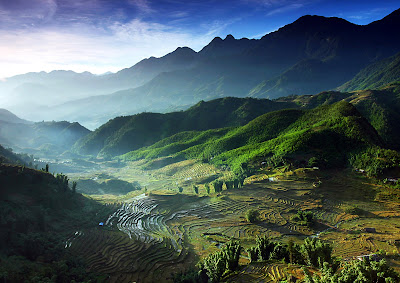
A PANORAMA OF SAPA

Itinerary
Get started: Taxi will pick you up at your hotel and transfer to Hanoi Railway Station for the night train at 9:15 PM to get to Lao Cai Station. Overnight on the train.

Day 1: Lao Cai – Sapa (B/L/D)

Arrive in Lao Cai early in the morning. Tour guide of ODC Travel will pick you up at Lao Cai Station then transfer by bus to Sapa (around 7.30 AM). Check in hotel & breakfast. Free to explore the town.

Overnight at hotel in Sapa


Day 2: Sapa – 15 km trekking, 17 km by car (B/L/D)

Breakfast at the hotel, take a car ride along Muong Hoa valley to visit the Rattan Bridge, Silver waterfall, the first village of the Red Dzao people (GiangTa Chai village).

Do a trek round 6 – 7 hours through the forests up and down in Fansipan range then reach Seo Trung Ho village of the Red Dzao. This is an almost untouched village and there are very few tourists getting here. Enjoy a most beautiful waterfall in Sapa which comes from a height of about 70 m.

Overnight home-stay at a Dzao family in Seo Trung Ho village

Day 3: Sapa – 17 km trekking in the forest (B/L/D)

Have breakfast with the family, start climbing up to the mountain for another untouched village: Ta Trung Ho village located at about 1450m above the sea level. Picnic lunch at the village and then descend Ban Ho village to visit Tay people whose have houses on stilts. Stay the night at Ban Ho village in a house on stilts. Have dinner with the family.

Overnight home-stay at a Tay family in Ban Ho village

Day 4: Sapa – 4 hours trekking, 23 km by car (B/L/D)

Breakfast at Ban Ho, go for a walk to a waterfall called Lavie which was discovered and named by the French in the past. Say goodbye to Ban Ho and the family to get up to Su Pan village where to take jeep back to Sapa. Have hot shower at the hotel and then take bus to Lao Cai Station for the night train to Hanoi.
Tour includes:
  • Transfer from the hotel to Hanoi Railway station
  • Roundtrip transfer in Sapa
  • Return train tickets Hanoi – Lao Cai – Hanoi (Soft sleeper with A/C – 4 persons in one cabin)
  • 1 night at hotel in Sapa
  • 2 nights home-stay in the villages
  • Full board meals
  • English speaking guide
  • Entrance fees
Tour excludes:
  • Travel insurance
  • Extra food and beverages
  • Phone and laundry
  • Tips and personal expenses

Read more!

11/17/09

Magnificent Halong Bay - Cat Ba Island

Day 1: Hanoi – Halong (-/L/D)

TiTop beachODC Travel’s tour guide and driver will pick you up between 7:30am and 8:00am at your hotel and transfer to Halong Bay (170km). Stop over at ceramic and hand embroidery workshops in Hai Duong (15 minutes) for refreshment and taking photos.


Arrival in Halong Bay, embark on a tender and transfer to luxurious wooden boat for a cruise in Halong Bay. After lunch, visit Sung Sot Cave - the most beautiful cave of Halong Bay and go swimming at Titop beach (or climb up to the top of the mountain to see the overview of bay). Admire landscape and take photos for the rest of the day. Dinner of fresh seafood is served and a show of traditional music on board.
Overnight on board.

Day 2: Halong Bay – Cat Ba Island – Lan Ha Bay (B/L/D)

Viet Hai VillageMorning cruise to Lan Ha Bay. On the way, you can admire the beautiful morning scenery of the World Heritage site. Stop over in Kiem Lam Wharf, transfer to small boat to Viet Hai. Trek 5km to Viet Hai village (the old fishing village located in the Cat Ba national park). Relax and take photos of the green fields and the daily lives of the local. Trek further along the path to the forest to visit an old house of Vietnam and the hidden local cave and the view of the forest.

Local lunch in a family at the village. Back to the harbor. Kayaking to explore “Tai Keo” lagoon and some sandy beaches then swimming and relaxing at Van Boi Beach. Boat trip to “Beo” Wharf, disembarking and check in your hotel. Dinner and overnight at hotel in Cat Ba.

Day 3: Cat Ba Island – Halong Bay – Hanoi (B/L/-)

Kayaking After breakfast, take a bus back to “Beo” Wharf. Get on the small boat and cruise along Lan Ha Bay then transfer to our sleeping boat. Stop over for swimming. On the way back to Halong, you will have a chance for sightseeing at Dinh Huong Island “Incense burner”, Cho Da Island "stone dog”, Ga Choi Island “fighting cocks”, etc.

After having lunch at restaurant in Halong City, return to Hanoi and drop off at your hotel.

Tour concluded.


Read more!

11/13/09

Vietnam Travel guides


MEKONG DELTA (VIETNAM)


Getting there: From Phnom Penh, we booked a ticket with the Capitol travel agency to get to Chau Doc by boat. The ride is painless and everything, including passing the border, is very well organized. We highly recommend this option.


What to do: Friends who have taken the 2-day tour on the Mekong with Sinh Cafe were enthuastic about it. My Tho and Ben Tre are worth a visit.

Where to stay: In Chau Doc, we stayed at Thuan Loi Hotel (18, Tran Hung Dao) with a view on the riverside. It was ok.

Where to eat: There are food stalls on the street. Just walk around and you will find! And exotic fruits from the market make a good desert.

HO CHI MINH CITY/SAIGON (VIETNAM)

Getting there: On our way to Ho Chi Minh City (that most local people still call Saigon), we took a local bus. It was not our best experience... We departed 3-hour late. The ticket controller was agressive. We were forced to keep our luggage on us even though there were many empty seats. The bus stopped everywhere. Locals were complaining about the vendors coming in and out, overpricing items and not giving back change. From that point, we decided to take a tourist bus.

Where to eat: Hard to say since we always mostly ate at relatives' places! But one place we would definitively recommend is Nam Giao, where you can find traditional food from central Vietnam (at 26/B13 + 14 Su Van Hanh nd, Quan 10, phone: 8621203 or at 136/15 Le Thanh Ton, Quan 1, phone: 8250261).

HOI AN (VIETNAM)

Getting there: We had a Sinh Cafe "open tour ticket". For 23 US$, you can get from Ho Chi Minh City to Hanoi and stop at different places on the way. The buses (all A/C) are on time, there are stops at points of interest along the way, the service is professional, and the driving safe.

What to do: Visit the typical old houses of Hoi An, walk along the river, go to the Japanese bridge, walk in the market and get yourself new clothes! We went to My Dieu's shop (#14 in the Hoi An cloth market, tel.: 0510. 863252) and were very satisfied. The first day, we only ordered few things. But the following days, seeing the result, we bought a lot more.

We also had shoes made at Hung Vi (tel.: 0510. 910658), the shop next door. Don't forget to mention that you wear socks! Otherwise, they may make your shoes too tight. The final result really suits your foot, and it feels great!

Where to stay: We stayed at Vinh Huy Hotel, which we do not recommend. It is where the Sinh Cafe agency took us. The service is not professional, intrusive, and we had three different rooms during our stay. The first night, they wanted to charge us 10$ while we agreed that we would not pay more than 6$. So they moved us the second day in another room with a "suicidal shower" (electrical shocks when you shower). On the third night, we had a small room with no windows. It was humid, and noisy. However, we have to say that the place is spotless, cheap (when they agree on charging 6 US$!), and... they have satellite TV!

Where to eat: Bobo Cafe (on Le Loi St.) was ok for breakfast. The well-known Cafe des amis (on the riverside) is now relatively expensive (approx. 30 000 VND) for what you get. For the same price, we preferred Nhu Y restaurant, in front of the cloth market. Along the riverside, we recommend Rose restaurant, where we had a good cao lau.

HUE (VIETNAM)

What to do: A visit to the royal tombs is a must, particularly Minh Mang's and Tu Duc's tombs (entrance fees: 55 000 VND for each). We hired a driver with motorbike for the whole day (5 US$) who also drove us to the famous Thien Mu pagoda.

Where to stay: We were at Mimosa Hotel (46/6 Le Loi), which we do not highly recommend. The family is very friendly, but the rooms are so-so (8-12 US$).

Where to eat: For breakfast, try Minh and Coco Mini Restaurant's pancake (1 Hung Vuong). For dinner, we recommend La Carambole (19 Pham Ngu Lao). If you like photography, you can have a coffee at Mandarin Cafe on Hung Vuong where the owner, a photographer, exposes his work.

HANOI (VIETNAM)

What to do: The most interesting things to do are not in Hanoi itself, but depart from Hanoi. Visiting Ha Long Bay is a must, as well as going on a trip to Sapa (which we regret not having done, but heard amazing things about). For any of these activities, we highly recommend ODC travel agency, with which we had a great service. It may not be the cheapest agency (compared to Sinh cafe's rates, for example), but what you get is way superior to what other agencies offer. ODC travel's office can be found in several locations: 43 Hang Bo and 142 Hang Bac streets (phone: (84.4) 828 8729 or 824 3024). A note on shopping: if you ever want to buy a traditional Vietnamese instrument, have a look at Thanh Tuan shop at 1C Hang Manh (phone: (84.4) 824 7166).

Where to stay: We stayed at Anh Dao Hotel (37 Ma May street) in the Old Hanoi Quarter. It was fine. At the time, we paid 10 US$ for a two-bed room with bathroom. The price included the breakfast and free Internet access. It was not our cheapest room, but it was the end of the trip so we decided to splash it all out!

Where to eat: There are many little places to eat. We liked Little Hanoi (there are two on Pho Ta Hien, we liked the one upstairs, if my memory is good, the address was 18). The food is good, but you may see a lot of backpackers since the restaurant is listed in the Lonely Planet... For excellent and more expensive food, there is the Tamarind Cafe (80 Pho Ma May, phone: 926 0580). It is stylish, and the background music would be something like the soundtrack of "In the mood for love"... For culinary experiences, try all these shops on the street that sell "banh cuon" (a kind of pancake made with rice flour) or "pho" (the traditional Vietnamese soup), for example. If they don't have a menu in English, then, you are likely to be in a good spot!

Read more!

11/12/09

ODC Travel Co., Ltd

Công ty Du lịch và thương mại Bảo Trung ODC
Địa chỉ: 65 Lý Nam Đế, Hoàn Kiếm, Hà Nội
Tel: 84 4 37478724
Website: http://www.odctravel.com.vn
Email: info@odctravel.com.vn

Read more!

11/3/09

Tra Co Beach

Tra Co is one of the most beautiful beaches in Vietnam. Located in Quang Ninh province, next to Vietnam - China border, Tra Co - a good and charming place for vacations is only 8 -9 kilometers away from Mong Cai town.Tra Co Beach is a famous tour attraction in Vietnam with broad fine sand beaches stretching for 17 kilometers from the cape named Got in the north to the cape named Ngoc in the south. Tra Co situates on the outer edge of the island. The coastline is bordered by 3-4 meters high sand dunes and peaceful fishing villages. The beach is shaded by a range of casuarina, protecting the village from the wind and the sand. Tra Co beach is an ideal place to spend holidays. If you spend your holiday on the fifth month of the lunar calendar, you can have a chance to take part in Tra Co Communal House Festival organized from the 30th of the fifth lunar month to the 6th of the sixth lunar month.

Weather:
Tropical monsoon climate. It’s hot and has a lot of rain in summer, in winter it’s cold and has a little rain. From May to September, it is the hot and rainy season, from November to March, it is the dry season. So there are enough four seasons in a year: spring, summer, autumn, winter. The average temperature in Tra Co is 22° 7C, although it tends to fall below 20°C from December to March. The hottest months are June and July when the temperatures reach 26 and 28°C. In July and August, there are many storms and typhoon. Therefore, you should not go on holiday on these months


How to get there:
Tra Co Beach can be reached by boat from Hai Phong to Mong cai (206km) or from Hong Gai (132km). From Hanoi, you can go by bus, then following Highway No 18 to Tien Yen - Hon Gai and after that turn to Road No 4 to Mong cai.

Specialties:
Tra Co is abundant in seafood: fish, cuttle- fish, crab, shrimp, especially Tra Co is well-known for local dishes made from king- crab.

Sightseeing:
When you come to Tra Co, please visit Tra Co Communal House, which was built in 16th century and Tra Co church built in 1880 and since then it has gone through many restorations. You can also come to visit Dong Hung town - China

Read more!

5/11/09

Halong Bay Tour (by photots)

Halong Bay Tour (by photots)

On 23/2/2009 I took part in Halong Bay Tour with ODC Travel. I felt very lucky and happy when I visited to Halong Bay - the World's Heritage. And these are some photos I took when I was there.


50


We started from Hanoi at 8h and stopped for rest and shopping in Sao Do - Hai Duong. I bought some thing there, It's very beautful but really expensive. And then we came to Halong city, we took a small boat to the Sun Cruise Boat from Halong Harbour.


Read more!

3/22/09

Hanoi - Halong Bay - Cat Ba Island

Duration: 3 Days/ 2 Nights

Transport: Bus, Boat

Code: ODC HL 03

Day 1: Hanoi – Bai Tu Long Bay – Halong Bay (-, L, D)

We will pick you up between 7:30am - 8:00am at your hotel and transfer to Halong Bay (170km). Stop over at ceramic and hand embroidery workshops in Hai Duong for relaxation and photos (15 minutes). Arrive in Halong Bay, embark on a tender and transfer to luxurious wooden boat for a cruise in Halong Bay. After lunch, visit Sung Sot Cave - the most beautiful cave of Halong Bay and go swimming at Titop beach (or climb up to the top of the mountain to see the overview of bay), admire landscape , take photos and so on. Dinner of fresh seafood is served and a show of traditional music on board. Overnight on boat in Halong Bay.


Day 2: Halong Bay – Cat Ba Island – Lan Ha Bay (Trekking – Kayaking) (B,L,D)

After breakfast, cruise to Lan Ha bay. On the way, you can admire the beautiful morning scenery of the World Heritage site. Stop over in Kiem Lam Wharf, transfer to small boat to Viet Hai. Trek 5km to Viet Hai village (the old fishing village located in the Cat Ba national park). Relax and take photos of the green fields and the daily lives of the local people. Trek further along the path to the forest to visit the “ Nha co” ( the old houses of Viet Nam) and the “Toi” the hidden local cave and the view of the forest. Lunch in the local family at the village. Back to the Habour. Kayak to explore “Tai Keo” lagoon, and some sandy beaches, swimming and relaxing at Van Boi Beach. Boat trip to “ Beo” Wharf. Dinner and O/N hotel in Cat Ba.

Day 3: Cat Ba Island – Halong Bay – Hanoi (B, L, -)

After breakfast, take a bus back to “Beo” Wharf. Get on the small boat. Cruise along Lan Ha Bay and transfer to the Sleeping boat. Stop over for swimming, snorkeling. On the way back to Halong, you will have a chance for sightseeing at Dinh Huong “Incense burner” island, Cho Da, "stone dog”, Ga Choi “ fighting cocks”, etc. After having lunch at restaurant in Halong City, return to Hanoi. Arrive in Hanoi. Tour finished.

Read more!

1/21/09

HUE ANCIENT CAPITAL

Hue is a quiet, relaxing city, big enough to be interesting but small enough to cycle around. The food is great, the best in Vietnam and the women are supposed to be the most beautiful in the country

KING MINH MANGS TOMB

Located 12 km far from the city on the left branch of the Perfume River, built as the plan drawn out by the King himself and on the place chosen by the King too in the middle of the pine forest. It took ten thousand soldiers and artisans to complete the project from 1840-to 1843. The tomb consists of about 40 monuments of various sizes; all lie within an oval shaped wall with a circumference of 2000m. A walk of about 700m in length bisects the interior of the complex into two equal halves. Along it are the Salutation Court, Stele House, Sung An Temple, Minh Lau Pavilion, and the tomb itself being at the very back of the complex.


KING TU DUCS TOMB
Tu Duc was the fourth emperor of The Nguyen Dynasty. He had his tomb constructed when still on the throne in 1848. It is 7 km far from the city; his tomb includes 50 monuments surrounded by a 1500m wall. Emperor Tu Duc was an expert in eastern philosophy, history, and literature. It comprises of an important number of buildings, man-made ponds full of nenuphars and lotuses, crossed by various bridges and covered by frangipanes. This is one of the most romantic and splendid masterpieces.
KING KHAI DINHS TOMB

Khai Dinh, the twelfth king of the Nguyen Dynasty and the father of King Bao Dai who is the last emperor of Vietnam. The construction started from 1920 to 1931. Emperor Khai Dinhs tomb is built using concrete, its roof with slates and the gate is made of wrought iron. The builder made use of the lighting rod and electricity is used to light the place. Beyond these modern building materials and designs, the tomb had elements of eastern art mixed with western designs. The conception of architecture and decoration got the European influence.

THIEN MU PAGODA

Located 6 km far from the city on the left branch of the Perfume River, this Buddhist monastery was erected in 1601 by Lord Nguyen Hoang, the ancestor of The Nguyen, on a used hilly brick foundation of a Cham building.
According to legend, the people around this area used to see a vision of an old lady appearing on the hill where the pagoda now sits. Upon seeing people, she always said that someday a great leader would build a pagoda at this site to bring peace to the country. One day, when Lord Nguyen Hoang passed by this area, upon hearing the story, he ordered the construction of the pagoda in 1601. He named it Chua Thien Mu - Heavenly Lady Pagoda.The Pagoda was the center of Buddhism in central Vietnam

Read more!

1/20/09

SAPA - FOG CITY

Sapa is famous for both its fine, rugged scenery and its rich culture diversity. Sapa is nestling of many ethnic minority village and vivid green rice terraces are sculpted into the mountain sides. It would be of considerably less interest without the HMong and Dzao people, the largest ethnic groups in the region. Its lush, deep river valleys, in the shadows of Vietnam’s tallest peak Mount Fansipan. ODC Travel - Sapa
In the center of town is the spectacle of Sapas famed market, which has become a fixture on standard Southeast Asian tourist itineraries. Treks through the surrounding mountainside are an opportunity to visit picturesque villages, most notably those of the Hmong and Red Dao people. One inconvenience that will not change is the weather. If you visit off - season, dont forget your witner woolies. Not only is it cold (0oC), but winter brings fof and drizzle. The chilly climate does have a few advantages, though - the area boasts temperate - zone fruit trees bearing fruit such as peaches and plums, and gardens for raising medicinal herbs. The dry season in Sapa lasts from around January to June. January and February are the coldest (and foggiest) months. From March to May the weather if often excellent, and the summer is warm despite the rains between June and August. The window from September to mid - December is a pleasant time to be in Sapa, though there is a bit of lingering rain at the start and the temperature dips by December Fansipan MountainFansipan Moutain (3143m), accross the valley from Sapa, is Vietnams highest peak and a popular expedition for those willing to brave its deceptively steep slopes.


The trail starts at the pink building just 1km before Tram Ton Pass. From that permit checkpoint, its a 3 - 4hr like up to the base camp (2200m). Everyone sleeps in the small hut at base camp, and you will be provided with a sleeping bag. The base camp has a makeshift bar and a river, where you can take a cold bath. Typically, trekkers reach the summit and return to base camp on the second day. The steep, muddy trail travels through the jungle and bamboo forest, and ropes have been set up on the larger rock faces. The round - trip from base camp to the summit takes roughly 8hr and there are great vatage points along the way. On top, you can take a picture holding the Vietnamese flag. The third day, one generally leaves base camp on a different route, heading down to Sin Chai, where ajeep or motorbike will pick you up and bring you back to Sapa.


Read more!

SAPA - FOG CITY

Sapa is famous for both its fine, rugged scenery and its rich culture diversity. Sapa is nestling of many ethnic minority village and vivid green rice terraces are sculpted into the mountain sides. It would be of considerably less interest without the HMong and Dzao people, the largest ethnic groups in the region. Its lush, deep river valleys, in the shadows of Vietnam’s tallest peak Mount Fansipan.
In the center of town is the spectacle of Sapas famed market, which has become a fixture on standard Southeast Asian tourist itineraries. Treks through the surrounding mountainside are an opportunity to visit picturesque villages, most notably those of the Hmong and Red Dao people. One inconvenience that will not change is the weather. If you visit off - season, dont forget your witner woolies. Not only is it cold (0oC), but winter brings fof and drizzle. The chilly climate does have a few advantages, though - the area boasts temperate - zone fruit trees bearing fruit such as peaches and plums, and gardens for raising medicinal herbs. The dry season in Sapa lasts from around January to June. January and February are the coldest (and foggiest) months. From March to May the weather if often excellent, and the summer is warm despite the rains between June and August. The window from September to mid - December is a pleasant time to be in Sapa, though there is a bit of lingering rain at the start and the temperature dips by December Fansipan MountainFansipan Moutain (3143m), accross the valley from Sapa, is Vietnams highest peak and a popular expedition for those willing to brave its deceptively steep slopes.

The trail starts at the pink building just 1km before Tram Ton Pass. From that permit checkpoint, its a 3 - 4hr like up to the base camp (2200m). Everyone sleeps in the small hut at base camp, and you will be provided with a sleeping bag. The base camp has a makeshift bar and a river, where you can take a cold bath. Typically, trekkers reach the summit and return to base camp on the second day. The steep, muddy trail travels through the jungle and bamboo forest, and ropes have been set up on the larger rock faces. The round - trip from base camp to the summit takes roughly 8hr and there are great vatage points along the way. On top, you can take a picture holding the Vietnamese flag. The third day, one generally leaves base camp on a different route, heading down to Sin Chai, where ajeep or motorbike will pick you up and bring you back to Sapa.


Read more!

HALONG BAY - WORLD HERITAGE


Halong is situated in the North – East region of Vietnam, lies 160 km to the east of Hanoi. Halong is a bay in the Gulf of Tonkin comprised of regions of Halong City. Halong borders Cat Ba Islands in the southwest, the east sea in the east and the mainland.

Halong is a natural wonder of the world and one of Vietnam’s five UNESCO World Heritage Sites. Halong is made up of 1.969 islands of various sizes. There are two kinds of islands; limestone and schist with over 3000 limestone islands emerge from emerald green water of Halong. While some islands are no more than large rocks, others are much more substantial and contain huge cathedral – like caves of stalactites. Most of the islands are clothed in thick green vegetation and ring with the sound of bird song in the early morning. Secluded sandy caves are everywhere an in the summer months the warm waters of the bay are ideal for swimming, snorkeling or kayaking. History shows that Halong Bay has been the setting for local naval battles against Vietnams coastal neighbours. On three occasions in the labyrinth of channels in Bach Dang river near the islands the Vietnamese army stopped the Chinese from landing. In 1288 General Tran Hung Dao stopped Mongol ships from sailing up the nearby Bach Dang River by placing steel-tipped wooden stakes at high tide, sinking the Mongol Dubhai Khans fleet.

Local legend says that long ago when the Vietnamese were fighting Chinese invaders, the gods sent a family of dragons to help defend the land. This family of dragons descended upon what is now Ha Long Bay (hence the name "Bay of Descending Dragons") and began spitting out jewels and jade. These jewels turned into the islands and islets dotting the bay, linking together to form barriers against the invaders. The people kept their land safe and formed what later became the country of Vietnam. The best way to appreciate the delights of Halong Bay is to cruise among the islands on a wooden boat while enjoying a tea or enjoy fresh seafood.


Read more!

1/19/09

HANOI CAPITAL

As the capital turning 1000 in 2010, Hanoi has within it the finest touch of what a Vietnamese cultural tradition of over a thousand years has to offer. The city hosts more cultural sites than any other city in Vietnam , including over 600 pagodas and temples. Even though some relics have not survived war and time, the city still has many interesting cultural and historic monuments for visitors and residents alike.


As a city between the rivers, built from lowland, Hanoi has many scenic lakes and sometime is called "city of lakes". Among its lakes, the most famous are Ho Guom (Sword Lake), Ho Tay (West Lake), Ho Thien Quang (Halais Lake), Truc Bach Lake, and Bay Mau Lake. Hanoi has famous traditional professional handicraft villages such as Bat Trang pottery village, Ngu Xa bronze casting village, Yen Thai glossy silk...

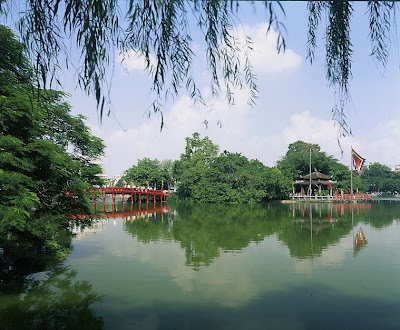
Among Hanois sightseeing highlights are the Ho Chi Minh Mausoleum and Museum; the National Art Museum; the grisly Hoa Lo Prison (also known as the infamous Hanoi Hilton); central Hoan Kiem Lake, where Hanoians enjoy brisk morning walks or tai chi in a tranquil city landmark that symbolizes the citys mythical origins; and the Old Quarter, whose narrow winding streets are named after the individual trades practiced here since the 15th century. Hanoi is Vietnam s cultural center, and the galleries, puppetry, music, and dance performances are worth staying at least a few days to take in.

Hoan Kiem Lake ( Lake of Restored Sword )
Hoan Kiem Lake ( Lake of Restored Sword ) is a famous landmark in Hanoi and a centre of the city. There is an interesting legend behind this lake. Apparently in the 15th century, Emperor Le Thai To of Vietnam was supposedly handed a magic sword by a divine tortoise living in the lake, thus helping him to repel invaders from China . After the country has been liberated, the tortoise snatched back the sword from the emperor and thus the lake is named " Lake of Restored Sword ". This lake was once part of the nearby Red Riber (Song Hung) and a swamp, until the French drained the land in the 19th century thus forming this lake. There are several species of tortoise living in this lake, and you will sometimes see them on the water surface. The area surrounding the lake is very beautiful with flowers, trees, benches, paths etc where both locals and tourist relax. Please see part 2 of this tip Hoan Kiem Lake is at the centre of Hanoi and a focus point of the city. The lake isnt too large and doesnt take too long to walk around. The lake is central to the locals as well as the tourists in Hanoi . If you visit early in the morning while it is still cool you will be able to watch the locals do Tai Chi. Badminton courts are painted onto the ground all around the lake and sometimes you will see the locals playing this too. The lake is a great place to meet people and see local life. It can be busy at times but this is due to the fact that the locals love and use this lake as much as the tourists. There are loads of shops and coffee bars around and its great to spend the afternoon people watching.

Van Mieu (The Temple of Literature)
The Temple of Literature is Vietnam s historical seat of learning and is the most sacred place for the disciples of Confucius. It is one of the few remaining buildings from the original city founded by Emperor Ly Thanth Tong in the 11th century and is a well-preserved example of Vietnamese architecture. It became the site of the countrys first university in 1076.
In the temple there are number of courtyards which separated by wall and gates. In the courtyards you will see pond covered with lilies, bonzai trees. The complex is quite large. The temple is surrounded by picturesque garden, manicured lawn and large trees which provide shades. The middle footpath with low hedges in both sides will guide you to the different part of the temple. In either side of the temple there are large tortoises engrave with list of people who graduated with their names, dates and places of birth who achieved doctorates. The Temple of Literature with Chinese architecture is well kept considering it was built in the in the 11th century. After the hustle, bustle and the chaotic of Hanoi traffic, it was quite relieved to visit one of the tourist attractions as it was nice, quite and relaxing.

Chua mot cot (One Pillar Pagoda)
The One Pillar Pagoda (Chua Mot Cot) is a small and famous Pagoda of Vietnam located at a premise near to the Ho Chi Minh Mausoleum and Ho Chi Minh Museum. The One Pillar Pagoda has become the symbol of Vietnamese rich culture and history. The pagoda was built in the reign of king Ly Thai Tong (1028-1054). According to legend, in his dream, in 1049, the king saw a vision of Kwan Yin. She led him to a shrine in the middle of a lotus pond. When he woke up, he consulted with his court and decided to replicate the shrine in his dream to dedicate it to Kwan Yin. The One-Pillar Pagoda, built of wood on a single stone, is designed to resemble a lotus blossom, symbol of purity, rising out of a sea of sorrow. Today, many tourists visited the pagoda to offer their worship and sought the Goddess for blessings.
Read more!

Vietnam Grand Experience Tour


Vietnam Grand Experience Tour

(21days/20nights)


Day 1: Arrival in Hanoi(-, -, D )
Arrive at Noi Bai airport. Pick up and transfer to a hotel. An afternoon tour of Hanoi. Visit The Temple of Literature, Tran Quoc Pagoda and then take a cyclo to exploring old quarter (1hour). O/N in Hanoi.

Day 2: Hanoi(B, L, D )
Spend all day exploring Hanoi. Visit Ho Chi Minh Museum, One Pilllar Pagoda, Sword Lake,Vietnam Museum of Ethnology, History Museum. O/N in Hanoi.

Day 3: Hanoi- Halong (B, L, D)
After breakfast at your hotel, depart for Halong Bay (170km). Stop over at ceramic and hand embroidery workshops in Haiduong. Arrive to Halong Bay. Board a boat for a cruise in Halong Bay. Visit magical grottoes, marvel at odd - shaped inslands and relax in the best scenic beauty ofVietnam. Surprised Cave, Titop Beach, the fish - farm. Stop for a swim and kayak ride. Lunch and Diner of fresh seafood are served on boat. O/N on boat.

Day 4: Halong - Ninhbinh (B, L, D)
Early in the morning, enjoy a sunrise cruise in the breathtaking scenery of Halong Bay. Continue to cruise to Soi Sim Beach. Stop for a swim and kayak ride. Then visit Ga Choi and Dinh Huong Island, Co Don, Cho Da Islet. After lunch at restaurant in Halong, transfer to Ninhbinh. Stop over in Hai Phong for visiting Hang Kenh Temple, Du Hang Pagode. Arrive in Ninhbinh, check in hotel. O/N in Ninhbinh.

Day 5: Ninhbinh - Hanoi(B, L, D)
First, take a sampan ride to Tam Coc, known asVietnams "insland Halong Bay". Then visit Hoa Lu, visit the Dinh Le dynasty temples, an ancient capital ofVietnam (968 - 1009). Return to Hanoi. O/N in Hanoi.

Day 6: Hanoi- Perfume Pagoda (B, L, D)
Depart for Perfume Pagoda. Arrive and walk to Yen wharf. Take a boat to visit Trinh Temple. Then trek up " Huong Tich" cave on the top of mountain. After lunch, visit Thien Tru pagoda and then back to Yen wharf. Then road trip back to Hanoi. In the evening, enjoy Hanoiis famed water puppet theatre. O/N in Hanoi.

Day 7: Hanoi- Hue(B, L, D)
Transfer to Noi Bai airport for a short fligh to Hue. Pick - up and transfer to a hotel. In the afternoon, take a boat on the Perfume River. Visit Thien Mu Pagoda, Hon Chen Temple and tomb of King Minh Mang. O/N in Hue.

Day 8: Hue(B, L, D)
A whole day exploring Hue. Visit the tomb of King Tu Duc and Khai Dinh. In the afternoon is sightseeing with a visit the Royal Citadel, Dong Ba Market, famous for its best conical hats inVietnam. O/N in Hue.

Day 9: Hue- Danang - Hoian (B, L, D)
Transfer to Hoian (140km). Stop over for visiting Lang Co Beach, Hai Van Pass. Visit Marble Mountains, stone - carving village of Non Nuoc in Danang. Arrive in Hoian. Check in hotel. At leisure for personal pursuits. O/N in Hoian.

Day 10: Hoian - Myson (B, L, D)
Travel on rural roads to My Son (55km), where explore the architectural treasure and sculptures of Cham culture dating from the 7th to the 13th century. In the afternoon, visit Japanese Covered Bridge, Thu Bon River, Old house of Tan Ky, Phuc Kien Assembly Hall. O/N in Hoian.

Day 11: Hoian - Danang - Buon Ma Thuot (B, L, D)
Before leaving for Danang airport. Stop for visiting Cham Museum which boasts the finest collection of Cham sandstone sculptures in the world. Take a short flight to Buon Ma Thuot. Pick - up and transfer to a hotel. Visit villages minorities.O/N in Buon Ma Thuot.

Day 12: Buon Ma Thuot - Dalat (B, L, D)
Transfer to Dalat, nestling of the Langbian Plateau at a elevation of 1,500m above sea level. Stop for visiting Lake Lak. Elephan ride and dugout ride to Mong villages of Yun and Mlieng. Gong show at Yun village. Arrive in Dalat, check in hotel. At leisure for personal pursuit. O/N in Dalat.

Day 13: Dalat - Muine (B, L, D)
Visit Bao Dais summer palace, Flower garden, Datanla waterfall. Then tranfer to Mui Ne. Arrive in Mui Ne, check in a hotel. At leisure personal pursuit: relaxing or swimming on the sandy beach. O/N in Mui Ne.

Day 14: Muine (B, L, D)
Spend a day at leisure for relaxing, swimming at a resort or roaming over coloured sand dunes at Hon Rom. O/N in Phan Thiet.
Day 15: Muine - Ho Chi Minh City (B, L, D)
In the morning, at leisure personal pursuits: swimming or relaxing. After lunch, transfer to Ho Chi Minh City, formerly called Saigon. O/N in Ho Chi Minh City.

Day 16: Ho Chi Minh City(B, L, D)
A whole day tour of Ho Chi Minh City. Visit Notre Dame Cathedral, Post Centre. In the afternoon, visit War Remnant Museum. Continue to visitChina town and Thien Hau Temple. O/N in Ho Chi Minh City.

Day 17: Ho Chi Minh City- Tayninh - Cu Chi Tunnels (B, L, D)
After breakfast, transfer to Tayninh (99km). Explore the construction between 1933 and 1955 and attend the monk prayer session to witness the daily mass held by the Cao Dai followers. After lunch, transfer to Cu Chi Tunnels, is considered a heroic district for its role in the anti American war in Vietnam. Explore the destruction, damage and defoliation all over the area. O/N in Ho Chi Minh.

Day 18: Ho Chi Minh City- Vinhlong - Cantho (B, L, D)
After breakfast, transfer to Vinh Long (140km). Boat ride on the Mekong River to visit Caibe floatting market, gardens....then visit Binh Hoa Phuoc island. Then on to Can Tho. O/N in Cantho.

Day 19: Cantho - Chaudoc (B, L, D)
Take a boat to visiting floating Phong Dien, then return to Cantho for lunch. After lunch, transfer to Chaudoc, is pleasant little town near the Cambodian border. Arrive in Chau Doc, visit Sam Mountain, Tay An pagoda. O/N in Chaudoc.

Day 20: Chaudoc - Ho Chi Minh City(B, L, D)
Before leaving Chaudoc, take a boat to visit Floating Houses and then visit the Mosques, the Cham village. After lunch, return to Saigon. O/N in Saigon.

Day 21: Departure from Ho Chi Minh City(B, L, -)


Spend last minutes shopping or at leisure before check - out. Transfer to the airport for departure.

Read more!

1/16/09

Halong Bay - 1 Day


We will pick you up between 730am - 800am at your hotel and transfer to Halong Bay (170km). Stop over at ceramic and hand embroidery workshops in Hai Duong(15 minutes). Arrive in Halong Bay, embark a wooden boat for a cruise in Halong Bay. Lunch of fresh seafood is served on board. Cruise among hundreds of islets to discover unspoilt pockets of Halong Bay.
OPT1: (4 hours)
Enjoy sunbathing and the magnificent scenery of Halong Bay, crusie to visit Thien Cung and Dau Go caves, fish-farm... At the end of the day, back to harbor and take a bus back to Hanoi. Arrive in Hanoi, tour finished
OPT2: (06 hours)
The boat stops for a visit to Sung Sot Cave, kayaking and swimming, taking photos and admiring the beautiful view. Back to harbor and take a bus to Hanoi. Arrive in Hanoi, tour finished.

Read more!

ODC Travel


Vietnamese name: Công ty TNHH Du Lịch và Thương Mại Bảo Trung ODC
Abbreviated name: ODC Travel
Decision: No. 0388/2005/TCDL-GPLHQT
License No.:0102000394 of April 27th, 2000 by Vietnam National Administration of Tourism
Tax code: 010101 3559
Head office: 65 Ly Nam De str - Hoan Kiem dist - Hanoi
Telephone:(84-4) 37478724
Fax: (84-4) 37475014
Bank account: 10741199 - Mrs. Ngo Thi Kim YenACB - Asia Commercial Bank
Email: info@odctravel.com.vn
Website: http://www.odctravel.com.vn/

ODC Travel commenced operations in 1997 in Hanoi. Since then we have carved out a name for ourselves as a provider of quality tours at affordable prices. We now have the staff of over forty enthusiastic travel professionals.
Our team is a diverse group of men and women who share a deep commitment to our unique style of travel to provide you with the holiday experience of a lifetime. They are not simply “couriers” who travel with you, but professional people who understand Vietnam history and culture, with a passion for their work.
Wherever you decide to travel, ODC Travel can make your vacation dreams come true. We are always committed to offering affordable rates and memories to last a lifetime.
Read more!